VEDC 2026 Announces 10 Teams Advancing to the National Final Round
The VEDC 2026 Organizing Committee has announced 10 outstanding teams from the North, Central and South regions that have earned places in the national final round, with many projects focused on edge AI, search and rescue, and cybersecurity.
The VEDC 2026 Organizing Committee has officially announced 10 outstanding teams from the three regions of the North, Central and South that have earned places in the national final round, after the Jury completed its evaluation of all projects in the Semi-final Round.
According to the announcement signed on 27 October 2026, the Organizing Committee of the Vietnam Electronics Design Contest 2026 (VEDC 2026) based its decision on the judging results and the Minutes of the meeting held on 26 October 2026 to agree on the selection results, choosing the teams that will enter the last stage of the competition. The VEDC 2026 Jury assessed the projects on the quality of the prototype, the hardware and software solutions, the ability to demonstrate and test the product, practical applicability, and each team’s presentation and defense. Each ticket to the next round therefore reflects a team’s overall capability rather than just a good idea on paper.
Among the 10 teams entering the VEDC 2026 final round, the Southern region has the largest number with four teams, while the Northern and Central regions contribute three teams each, creating a balance among engineering training centers across the country.
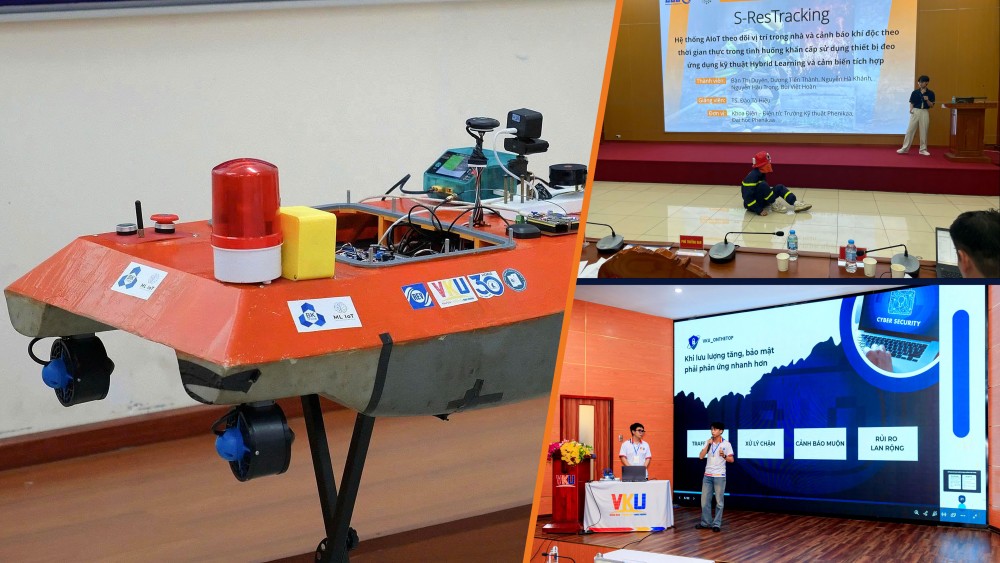
All three Northern teams that earned places in the final stage of VEDC 2026 bring projects of high technical difficulty. Team S-ResTracking (MB59) from Phenikaa University is researching an AIoT system for real-time indoor location tracking and toxic gas warning in emergency situations, using wearable devices that apply Hybrid Learning techniques and integrated sensors. The Military Technical Academy is represented by team MTA MicroWings (MB46) with EdgeAI-Rescue, a real-time search and rescue system integrating edge AI processing on the KV260 platform. Team KLM - KMA (MB43) from the Academy of Cryptography Techniques chose the field of information security, designing a three-layer anti-eavesdropping system for LoRa/IoT communication networks that combines passive defense, active defense and adaptive AES encryption using multi-agent reinforcement learning.
The Central region brings to VEDC 2026 three projects focused on monitoring and protecting infrastructure. Team ECO UAV (MT12) from the University of Science and Technology, The University of Danang, is developing a UAV for environmental monitoring and smart patrolling. Team VKU_OnTheTop (MT6) from the Vietnam – Korea University of Information and Communication Technology, The University of Danang, is building a real-time network intrusion detection system accelerated by FPGA hardware. Team QNU-AI (MT27) from Quy Nhon University completes the Central region’s list with RoadSense AIoT, an embedded system integrating a camera, Edge-AI and multiple sensors to monitor, locate and warn of road surface damage in real time.
|
No. |
Team code |
Team name |
Project title |
Institution |
|
I. NORTHERN REGION |
||||
|
1 |
MB59 |
S-ResTracking |
AIoT system for real-time indoor location tracking and toxic gas warning in emergency situations using wearable devices applying Hybrid Learning techniques and integrated sensors. |
Phenikaa University |
|
2 |
MB46 |
MTA MicroWings |
EdgeAI-Rescue: Real-time search and rescue system integrating edge AI processing on the KV260 platform. |
Military Technical Academy |
|
3 |
MB43 |
KLM - KMA |
Design of a three-layer anti-eavesdropping system for LoRa/IoT communication networks using passive defense, active defense and adaptive AES encryption with multi-agent reinforcement learning. |
Academy of Cryptography Techniques |
|
II. CENTRAL REGION |
||||
|
4 |
MT12 |
ECO UAV |
UAV for Environmental Monitoring & Smart Patrolling. |
University of Science and Technology – The University of Danang |
|
5 |
MT6 |
VKU_OnTheTop |
Real-time Network Intrusion Detection System Accelerated by FPGA Hardware. |
Vietnam – Korea University of Information and Communication Technology, The University of Danang |
|
6 |
MT27 |
QNU-AI |
RoadSense AIoT – Embedded system integrating a camera, Edge-AI and multiple sensors for real-time monitoring, locating and warning of road surface damage. |
Quy Nhon University |
|
III. SOUTHERN REGION |
||||
|
7 |
MN18 |
MLIoT_RedgeSCUE |
Autonomous rescue buoy integrating Edge AI to search for victims after floods. |
Ho Chi Minh City University of Technology, Vietnam National University Ho Chi Minh City |
|
8 |
MN42 |
31µF |
EdgeFlow AI: Distributed traffic light control system applying embedded AI, optimizing traffic flow based on a weighted-edge street network graph model. |
FPT University Ho Chi Minh City |
|
9 |
MN16 |
AD Connected - TTLab |
Research and development of a battery-free indoor positioning system using NFC-BLE tags. |
University of Information Technology, Vietnam National University Ho Chi Minh City |
|
10 |
MN9 |
ECOBOT |
Autonomous vehicle system with integrated edge processing and waste sorting (Edge AI). |
Joint team: University of Technology and Engineering (UTE) – University of Science (HCMUS) |
The four Southern teams in the VEDC 2026 final round address problems closely tied to urban life and natural disasters. Team MLIoT_RedgeSCUE (MN18) from Ho Chi Minh City University of Technology, Vietnam National University Ho Chi Minh City, has built an autonomous rescue buoy integrating Edge AI to search for victims after floods. Team 31µF (MN42) from FPT University Ho Chi Minh City presents EdgeFlow AI, a distributed traffic light control system applying embedded AI to optimize traffic flow based on a weighted-edge street network graph model. Team AD Connected - TTLab (MN16) from the University of Information Technology, Vietnam National University Ho Chi Minh City, is researching and developing a battery-free indoor positioning system using NFC-BLE tags. Team ECOBOT (MN9), a joint team from the University of Technology and Engineering (UTE) and the University of Science (HCMUS), is developing an autonomous vehicle system with integrated edge processing and waste sorting.
Looking at the list as a whole, six of the ten projects in the final stage of VEDC 2026 are directly related to edge AI processing or embedded AI. They range from TinyML on edge devices by Phenikaa University, AI processing on the KV260 platform by the Military Technical Academy and RoadSense AIoT by Quy Nhon University, to the autonomous rescue buoy, the smart traffic light system and the waste-sorting vehicle by the three Southern teams.
A second clear trend at VEDC 2026 is the spirit of serving the community. Three projects target search and rescue in emergencies: the firefighter support system, EdgeAI-Rescue and the post-flood rescue buoy. Two other projects, from the Academy of Cryptography Techniques and the Vietnam – Korea University of Information and Communication Technology, focus on protecting network security. The Organizing Committee stated that the results recognize the creativity, research efforts and ability to turn technical solutions into reality shown by the teams in the fields of electronics, embedded systems, artificial intelligence and related technologies.
The VEDC 2026 Organizing Committee asked the teams to continue refining their products and to prepare their demonstrations, presentations and defense plans so they are ready for the final round. Official information on the time, venue, format and technical requirements of the VEDC 2026 final round will be sent to the teams in a subsequent announcement, so team leaders should regularly check their email and the contest’s official communication channels.
Along with its congratulations to the ten outstanding teams from the North, Central and South regions, the VEDC 2026 Organizing Committee also expressed its thanks to the teachers, training institutions and teams who have shown interest in, registered for and accompanied the contest throughout the journey so far.






Minimum 10 characters Accented Vietnamese Does not contain links
Post a comment